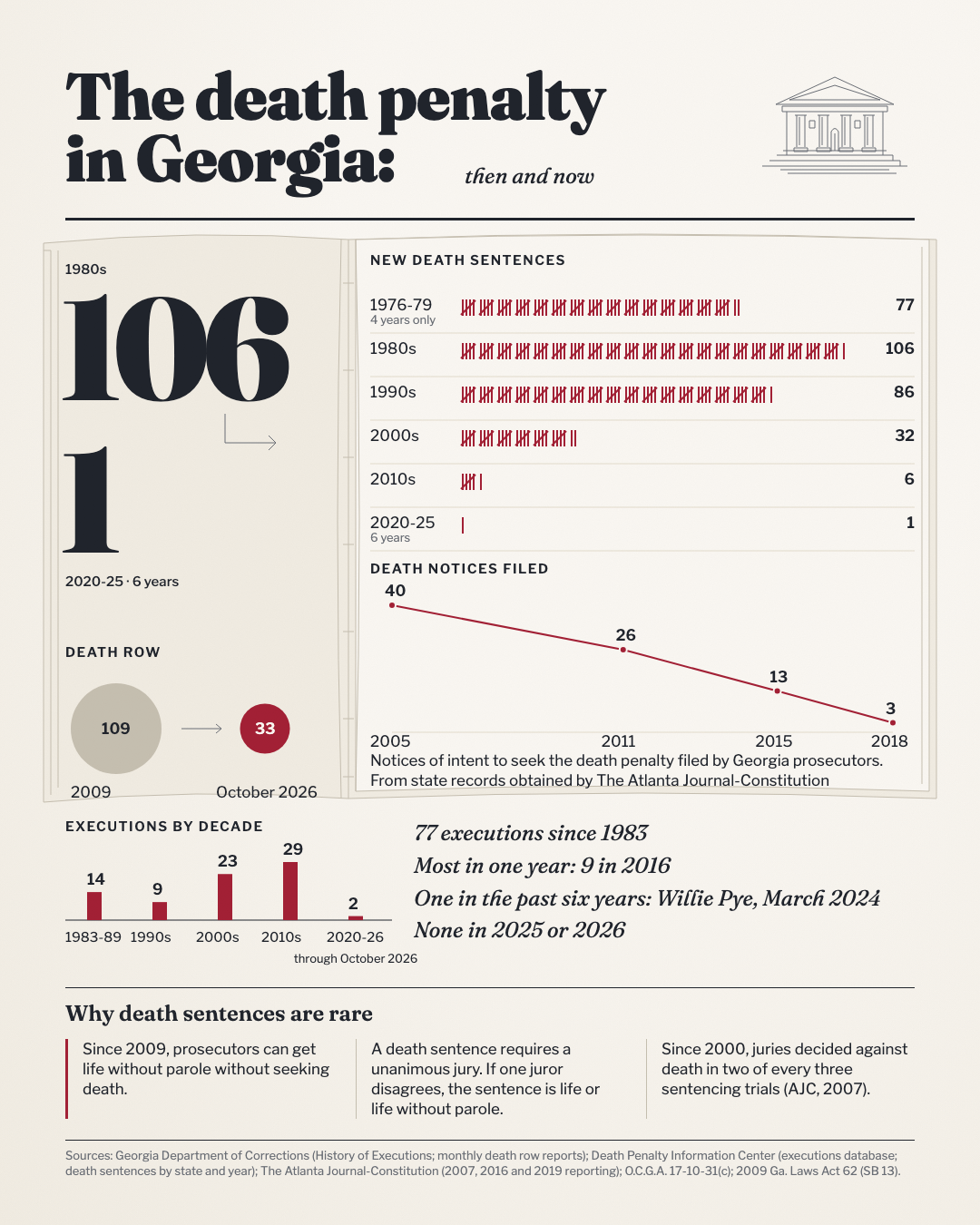
I see comments from folks on Facebook about the death penalty. Why we didn’t ask for it in a particular case. It’s a fair question, and it deserves a serious answer. First, let me say that there is a checklist of criteria that must be met before you even file a death notice in a case. And it’s binary. You either meet the criteria or you do not. Georgia has 33 people on death row. In the past six years the state has carried out one execution, and none in 2025 or 2026.
A death sentence in Georgia doesn’t end the case. It starts a new one that can run for decades. The Georgia Supreme Court must review every death sentence, and from there it can go to the U.S. Supreme Court. Then comes a new lawsuit in Butts County, where death row is, challenging the conviction and sentence, and from there back up to the Georgia Supreme Court and the U.S. Supreme Court again. Then another new lawsuit in federal court, an appeal to the Eleventh Circuit, sometimes to the full court, and a third trip to the U.S. Supreme Court. When all of that is done comes the execution order, then a clemency hearing before the Parole Board and last-minute suits in state and federal court.
Willie Pye is the one person Georgia has executed in the past six years. The killing was in November 1993. He was sentenced to death in June 1996, and the Georgia Supreme Court affirmed it in 1998. His lawsuit in Butts County was filed in 2000 and denied in 2012. That’s twelve years in one court on one stage. His federal case was filed in 2013 and denied in 2018. In April 2021 a three-judge panel of the Eleventh Circuit threw out the death sentence. In October 2022 the full Eleventh Circuit reversed that. In October 2023 the U.S. Supreme Court declined to take the case. That’s another ten years in federal court. He was executed on March 20, 2024, 30 years after the crime. Nationally, the people executed in 2023 had spent an average of about 23 years on death row.
In November 2003, two people were killed in Cobb County. The man convicted was sentenced to death in September 2007, and the Georgia Supreme Court affirmed in 2010. His Butts County case ran from 2011 to 2016, and the Georgia Supreme Court refused the appeal in 2017. His federal case ran from 2018 until October 2025, when the U.S. Supreme Court declined it. The execution was set for December 17, 2025. Two days before, the Parole Board suspended it amid a fight over a board member’s conflict of interest, and then a Fulton County judge blocked a new date for months. It was reset for September 16, 2026. The night before, a Cobb County judge stayed it for a hearing under a 2025 Georgia law that lets someone already serving a sentence ask to be resentenced if abuse they suffered was a significant factor in the crime. His lawyer cited childhood abuse. The Georgia Supreme Court left the stay in place and hears argument December 8. That’s nearly 23 years since the crime, 19 since the sentence, and still no end.
For a family, a death sentence doesn’t close anything. It opens decades of waiting on the next ruling, with no say in when it comes or how it turns out.
And once the jury returns a death sentence, those decades are out of our hands. After trial, our office and the Attorney General’s office answer the first appeal together, and from then on the Attorney General represents the State in the lawsuits that follow, in state and federal court. The courts set the pace. What comes back to the district attorney is asking a judge for an execution order when every court is finished, and as that Cobb County case shows, even then the date can be stopped.
I will tell you that I support the death penalty. But as things stand, it is technically legal but practically almost impossible. And during the 25-30 years of endless appeals and court dates the ones who need closure the most are the ones who can’t move on.